
Pagezii vs Crayon: Which Competitor Monitoring Tool Is Right for Your Stage?
Synopsis
Direct comparison for buyers evaluating both tools. Covers setup time, pricing, target user, and intelligence depth. Honest about where Crayon wins. Clear about where Pagezii is the more practical choice for early-to-mid-stage teams.
Two Different Competitor Monitoring Tools for Two Different Stages
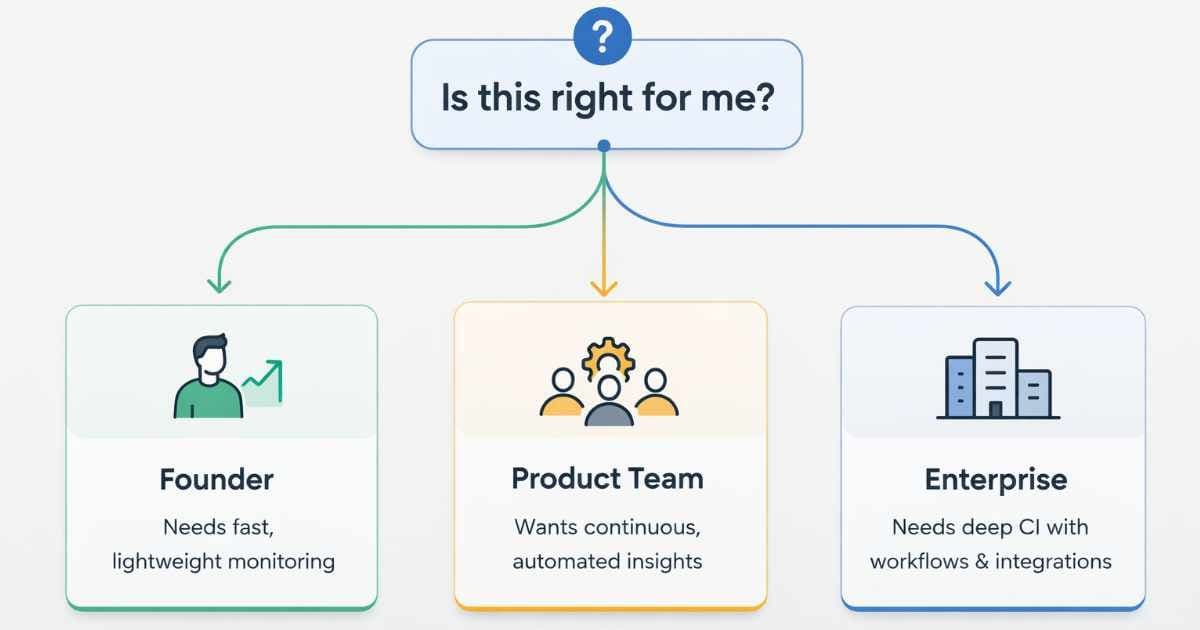
Pagezii vs Crayon is the wrong question for most early-stage teams. The right question is whether you need a competitor monitoring tool built for enterprise CI teams or one built for founders who want signals today.
Crayon and Pagezii are both competitor monitoring tools. That is roughly where the similarity ends.
Crayon is built for enterprise teams with dedicated competitive intelligence functions. It aggregates data across many sources, integrates with sales tools, and is designed to support a CI analyst or a team of people whose job is competitive intelligence.
Pagezii is built for founders and product leads who need to know when competitors move, without a sales conversation, a contract, or a CI team.
If you are evaluating both, the right question is not which one is better. It is which one matches where you are right now.
Crayon needs a CI analyst to process signals. Pagezii is built for the founder who receives the alert and makes the call themselves.
Setup and Time to Value
Getting started with Crayon requires a sales conversation. You request a demo, go through a discovery call, get a proposal, and sign a contract. The timeline from first contact to live monitoring is typically measured in weeks, sometimes longer depending on procurement.
Enterprise CI tools require long procurement and complex rollout. If a competitor moves this week, you need a lightweight monitoring tool you can turn on immediately, like Pagezii.
Pagezii takes 10 minutes. You sign up, add competitor URLs, select pages to monitor, and the system starts building a baseline. No demo required. No contract. No procurement process.
For founders and product leads who need intelligence now, the time-to-value difference is significant. You can be monitoring your top three competitors on Pagezii before you would have finished scheduling a Crayon demo.
Pricing and Contract Structure
Crayon does not publish pricing publicly. You get a number after a sales conversation, and the number is sized for enterprise budgets. Most plans include annual contracts.
Pagezii pricing is public. The Starter plan is $29 per month for three competitors. The Growth plan is $79 per month for ten competitors. The Pro plan is $149 per month for 25 competitors. No hidden fees. No annual contract required. Founding pricing is locked in for early members.
For a team that is not yet at the stage where competitive intelligence is a line item in a formal budget, the difference matters.
Target User
Crayon's ideal user is a competitive intelligence analyst or a product marketing manager at a company with a dedicated CI function. The product is designed around the assumption that someone's job is to process, synthesize, and distribute competitive intelligence across the organization.
Pagezii's ideal user is a founder, product lead, or growth operator who wants to know when a competitor moves — and wants to know fast, without routing the information through an analyst or a process. The product is designed around the assumption that the person monitoring is the same person making decisions.
For a direct look at which type of user gets the most value from Pagezii, read is Pagezii right for you.
Depth of Intelligence
Crayon aggregates competitive data from a wider range of sources: review sites, job postings, social media, news, and more in addition to web pages. For enterprise teams running formal competitive programs, that breadth has value.
More data sources are not always better. For founders without a CI analyst, broad aggregation produces noise. Focused page monitoring produces decisions.
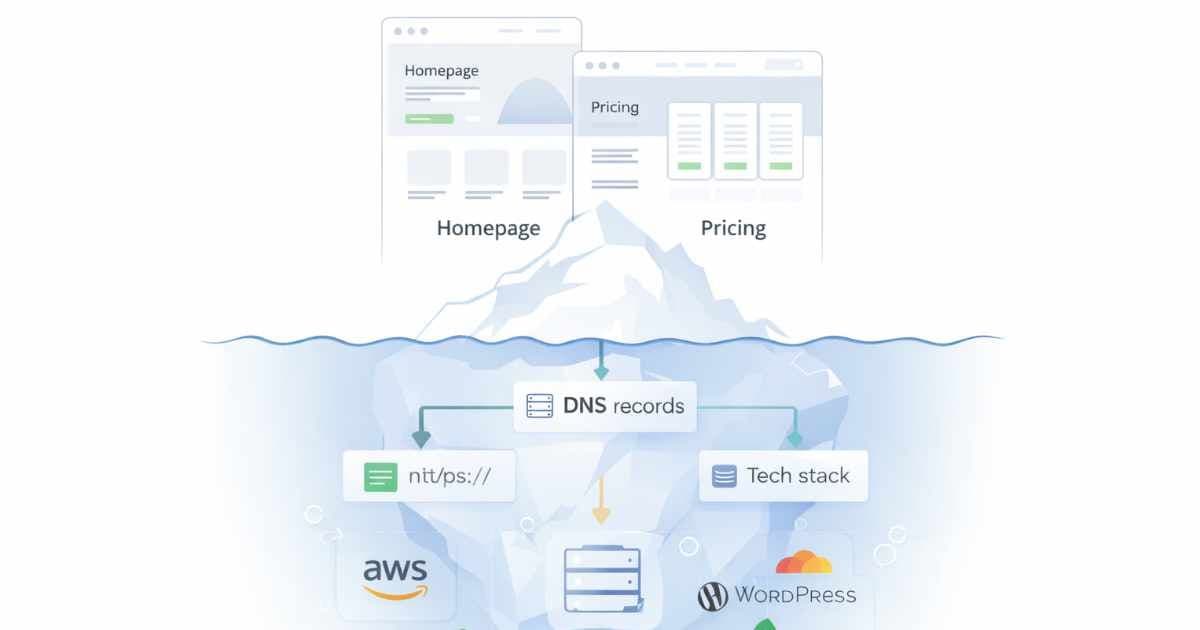
Pagezii focuses on the highest-signal sources: pricing pages, features pages, homepage, blog, product pages, DNS, and tech stack. For most early-to-mid-stage companies, these are the pages that produce the moves that actually matter to daily decisions.
The breadth Crayon offers is genuinely useful at scale. At earlier stages, it can also produce more noise than signal if there is not a dedicated person to process it.
Where Crayon Wins
Crayon is the right choice for companies with a large sales team that needs competitive battlecards, a dedicated CI analyst, an enterprise budget, and a procurement process that can support an annual contract. If that is your situation, Crayon is built for you.
Where Pagezii Wins
Pagezii is the right choice for founders and product leads who need competitor signals today, not after a procurement process. Self-serve setup, public pricing, and a focus on the highest-signal page changes make it the faster, more practical choice for companies that are still finding and defending their market position.
For a comparison with another enterprise CI tool, read Pagezii vs Klue: competitor monitoring tool comparison.
If you are comparing Pagezii vs Crayon, the real decision is whether you need an enterprise competitive intelligence platform or a competitor monitoring tool that starts in 10 minutes.
About the Author

Zaki Usman
Co-founder Pagezii
Zaki Usman
Co-founder Pagezii
Zaki is Pagezii cofounder, a startup operator building practical software tools that solve market problems for founders and growth teams.
Frequently Asked Questions
Crayon is an enterprise competitor monitoring platform used by larger sales and product teams. It aggregates competitor data across many sources and is designed for teams with dedicated competitive intelligence functions.
Audience Context
For founders and product leads actively comparing tools. They care about fit for their stage — not the most powerful tool, but the right one for right now.
Related Insights
- The Real Cost of Manual Competitor Tracking — Why "free" tracking has a hidden price tag
- Pagezii vs Klue: Monitoring vs Sales Enablement — Compare two tools solving different problems
- Is Pagezii Right for Your Team and Stage — Honest fit guide before you commit
- 30 Days of Automated Competitor Tracking — What Pagezii produces in the first month
- Replace Your Competitor Spreadsheet with Pagezii — Switch in one day, no setup complexity
References
- Gilad, B. (2015, July 30). Companies collect competitive intelligence, but don’t use it. Harvard Business Review.
https://hbr.org/2015/07/companies-collect-competitive-intelligence-but-dont-use-it - Gilad, B., & Hoppe, M. (2016, June 15). The right way to use competitive intelligence. Harvard Business Review.
https://hbr.org/2016/06/the-right-way-to-use-competitive-intelligence - Olszak, C. M. (2023). Competitive intelligence as a lever of added value. Procedia Computer Science, 219, 1426–1433.
https://www.sciencedirect.com/science/article/pii/S1877050923013273 - Gupta, M., George, J. F., & Xia, W. (2021). Big data analytics in building the competitive intelligence of organizations. Information & Management, 58(3), 103384.
https://www.sciencedirect.com/science/article/abs/pii/S0268401220314304 - Venn Innovation. (2017, September 27). Information does not guarantee insight: How to use the competitive intelligence that you collect.
https://www.venninnovation.com/en/blog/2017/9/28/information-does-not-guarantee-insight-how-to-use-the-competitive-intelligence-that-you-gather
Disclaimer
This article is provided for informational purposes only. Pagezii aims to share practical insights on competitor tracking and market intelligence but does not guarantee completeness, accuracy, or specific business outcomes.